Cook vs Order: How to Decide What's Best for Tonight
Should you cook at home or order in? Here's a practical comparison covering cost, time, health, and mood to help you decide once and for all.
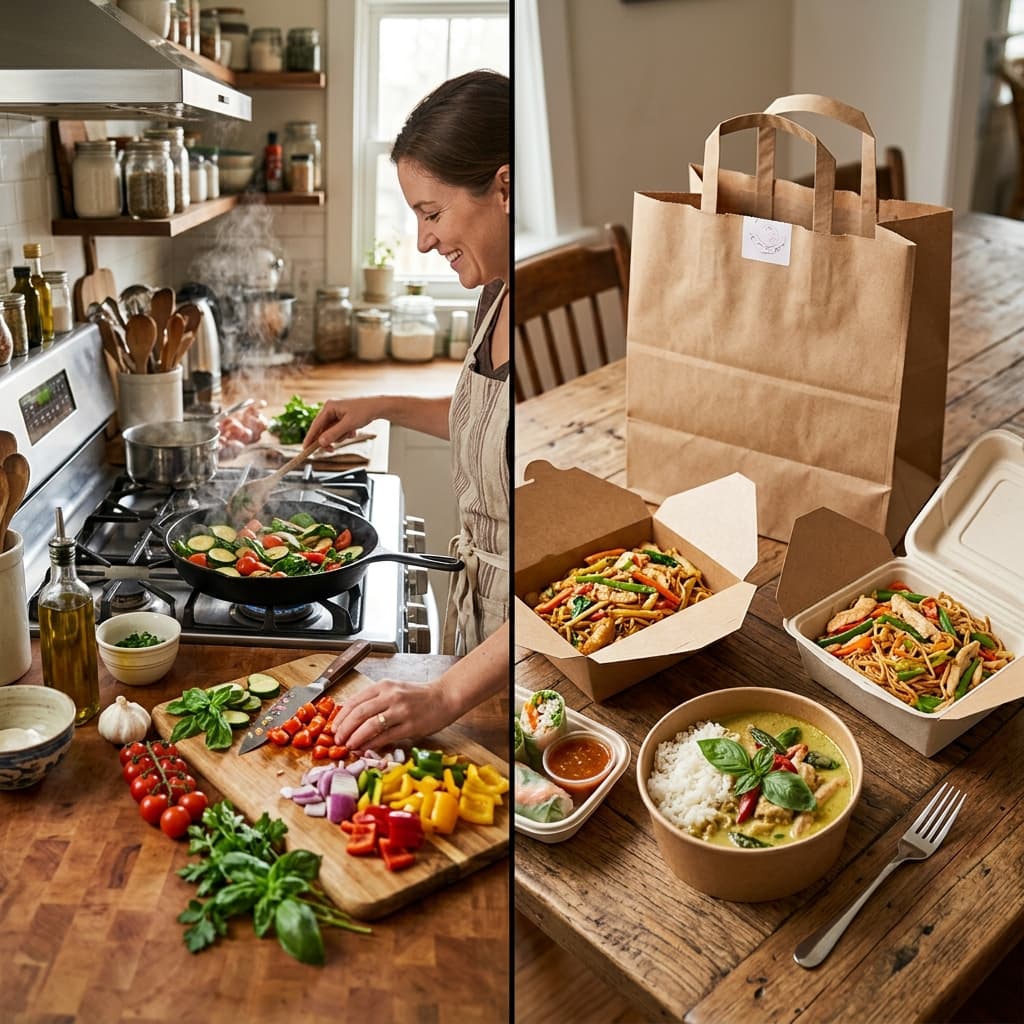
It's 7 PM. You're tired. The eternal question echoes: "Should I cook or just order?" Let's settle this debate with a practical framework you can use every single night.
The Real Cost Comparison
Let's break down the actual cost of cooking vs ordering for a typical Indian meal for two:
| Factor | Cooking at Home | Ordering In |
|---|---|---|
| Cost (for 2) | ₹100–200 | ₹400–800 |
| Time | 30–60 minutes | 30–45 min wait |
| Effort | Active cooking + cleanup | Minimal |
| Health Control | Full control | Limited |
| Satisfaction | High (pride factor!) | Instant gratification |
On average, ordering food costs 3–4x more than cooking the same dish at home. Over a month, that's ₹6,000–10,000 extra if you order just 3 times a week.
When You Should Definitely Cook
- You have more than 30 minutes — Most home meals take 20–40 minutes. That's often the same as delivery wait time.
- You have ingredients at home — Don't let that spinach go bad. Use our ingredient search to find recipes for what's in your fridge.
- You're trying to eat healthy — Restaurant food typically has 2x more oil, salt, and sugar than home-cooked meals.
- It's a weekend — Cooking can be therapeutic. Put on some music and enjoy the process.
- You want to impress someone — Nothing says "I care" like a home-cooked paneer butter masala.
When Ordering Makes Total Sense
- You're genuinely exhausted — After a 12-hour workday, there's no shame in ordering.
- You're craving something complex — Biryani from scratch? That's a 2-hour commitment. Order it.
- You have guests arriving soon — When time is tight, delivery is a lifesaver.
- It's a special occasion — Sometimes you deserve restaurant-quality food at home.
- You want to try something new — Exploring a cuisine you've never cooked is risky. Order first, then learn to cook it.
The Hybrid Approach: Best of Both Worlds
Here's what smart eaters do — they combine cooking and ordering strategically:
- Cook your base, order the special — Make rice and dal at home, order one special curry.
- Prep lunch, order dinner — Cook during the day when you have energy, order at night when you don't.
- The 80/20 rule — Cook 80% of your meals, order 20%. Your wallet and waistline will thank you.
Quick Decision Tree
Still can't decide? Follow this:
- Do you have more than 30 minutes? → Cook
- Are you craving something specific you can't make? → Order
- Do you have fresh ingredients? → Cook
- Is it past 9 PM and you haven't eaten? → Order
- None of the above? → Let What 2 Eat decide
The Bottom Line
There's no universally "right" answer. The best choice depends on your energy, time, budget, and mood. The key is being intentional — don't order out of habit, and don't cook out of guilt.
Use What 2 Eat to get personalized suggestions whether you're in cooking mode or ordering mode. We'll match you with the perfect option either way. 🍳📱
Frequently Asked Questions
Is it cheaper to cook at home or order food?+
When should I order food instead of cooking?+
What is the 80/20 rule for cooking and ordering?+
Keep Reading
Budget Meals Under ₹100: Eat Well Without Breaking the Bank
Think healthy, tasty food has to be expensive? These delicious Indian meals cost under ₹100 to make and prove that eating well is a skill, not a salary.
Tips & GuidesMeal Prep for Beginners: The Indian Kitchen Guide
Save time, money, and stress with meal prepping. Here's a practical Indian-style meal prep guide for busy professionals and students.